What A Blend Actually Is
A Single Design Specification, Sourced From Wherever Makes Sense.
Most furniture conversations start with a product question: new or used? A Blend starts with a design question instead: what does this space need to do, who is using it, and what is the budget and timeline?
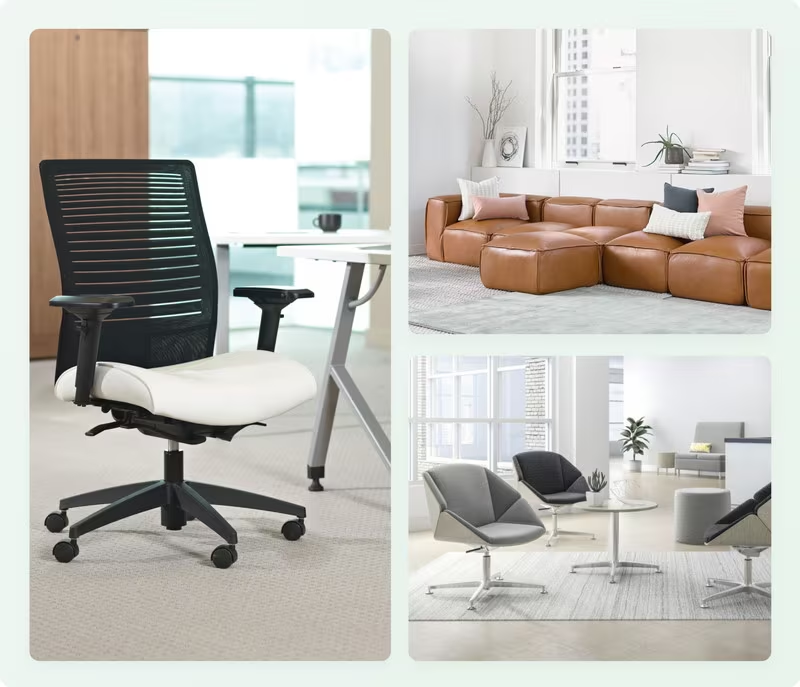
From there, every piece in the room is specified individually. The piece that needs to be new gets specified new. The piece that works just as well from premium pre-owned inventory gets pulled from pre-owned. The piece you already own and want to keep stays in the room, refurbished if it needs it. Every selection is a deliberate choice driven by the project.
The result is one coordinated design, one Bill of Materials, one project schedule, and one installation day. Not a new-furniture order plus a used-furniture order plus a refurbishment job. One project.
How We Build A Blend
From Walkthrough To Installation.
One Accountable Team.
The same designer who scopes your project sees it through to installation day. No handoffs between vendors, no finger-pointing about who specified what.
Step 1
Walkthrough Or Photo
Analysis.
We meet you on-site or review photos you send. The goal is to inventory what you have, identify what is worth keeping, and understand the use of every space.
Step 2
Space Plan And Specification.
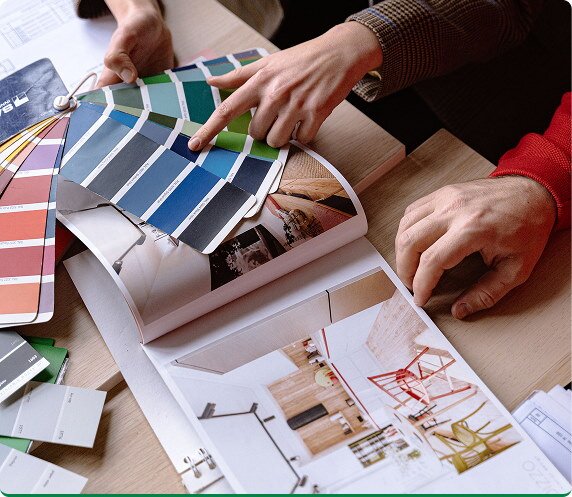
Our designers translate the walkthrough into a 2D space plan with a draft Bill of Materials drawn from all three streams. For complex projects, we add 3D visualization.
Step 3
Two Options. Your Feedback.
We typically present two design directions and ask which is closer to right. From there, we refine finishes, swap pieces, and adjust the budget until the spec hits.
Step 4
Installation As One Project.
New furniture arrives staged at our warehouse. Pre-owned is inspected and prepared. Your existing pieces are refurbished. All three streams install together on the same day.
When A Blend Makes The Most Sense
Three Situations We See Constantly.
If your project matches one of these, a Blend is almost always the right approach. If it does not, we will tell you and recommend something else.
Growing Team
Doubling Headcount, Same Lease.
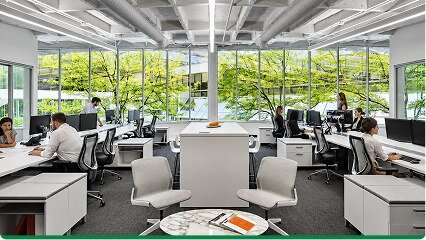
You’re hiring fast and need to add 30, 50, or 100 workstations into a space that already has functional furniture. New ergonomic seating for the new hires, pre-owned cubicles to scale the floor plate, and refurbishment of your existing executive offices.
Typical outcome: 40 to 55% cost savings vs all- new
Lease Renewal
Renewing, But The Office Needs A Refresh.
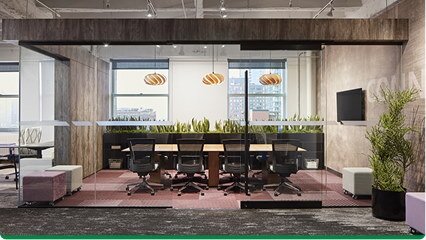
The lease is signed for another five years. The furniture is tired but mostly functional. Strategic blend of refinished conference tables, reupholstered seating, new task chairs for high-use roles, and a few new statement pieces for client-facing areas. A second life without a rebuild.
Typical outcome: Refresh at 25 to 35% of full- replacement cost
New Office
First Build-Out On A Tight Timeline.
You signed a lease 60 days ago. Construction is wrapping. You need to be open. New furniture lead times are 8 to 16 weeks. A Blend lets you open the space on time with pre-owned inventory while new orders arrive in a second installation phase.
Typical outcome: Move-in date held, no schedule slip
Why Buyers Choose A Blend
What Actually Changes When You Buy Furniture This Way.
The Blend approach is not a sales pitch. It changes a handful of specific, practical things about your project. These are the four that matter most.
No Handoffs
One Specification, One Team, One Schedule.
A typical office project can involve a furniture dealership, a used-furniture dealer, and a refurbishment vendor. Three quotes, three timelines, three install dates, and finger-pointing when something does not fit. A Blend collapses all three into one project under one accountable team.
Compressed Timelines
Open On Schedule Even When New Lead Times Cannot.
New contract furniture is manufactured to order. If your move-in date is sooner than the manufacturing window, a Blend lets you open the space on time by pulling pre- owned and existing pieces forward while new orders arrive in a later phase.
Budget Redistribution
Premium Where It Counts. Practical Everywhere Else.
The Blend approach lets the same project budget go further. Investment in the rooms and pieces that matter most. Practical, commercial-grade sourcing in the spaces that do not need a new specification. You decide the priorities. We map the spend to them.
Coordinated Result
A Finished Space That Looks Specified, Not Mixed.
Done badly, mixing sources produces a workspace that looks like a hand-me-down assembly. Done well, it produces a finished design where most visitors cannot tell which pieces are new and which are not. The difference is the specification work upfront, and that is the work we do.
Frequently Asked Questions
The Most Common Blend Questions.
The questions buyers raise on the walkthrough, in the proposal review, and right before signing. All in one place.
What exactly makes something a Blend versus just buying new and used at the same time?
A Blend is a single integrated specification. The space is designed as one room, every piece is selected together, and the project ships as one delivery against one schedule. Buying new from one vendor and used from another is not a Blend, it is two projects running in parallel. Coordinating them is your job. A Blend coordinates them for you.
Will my finished space look cohesive, or will the pieces look mismatched?
A Blend is curated, not random. Our designers select every piece by color palette, scale, finish, and style so the room reads as one specified design. You see the finished concept in 2D and 3D before anything is ordered. If a piece does not fit, it does not go in.
Who is accountable if something goes wrong on installation day?
We are. One designer scopes the project, one team manages it, and one crew installs it. If anything is wrong on install day, you call one number. There is no vendor-to-vendor handoff to debug. That is the entire operational point of running a project as a Blend.
How do you decide what goes into a Blend versus what gets specified new across the whole project?
We walk the project with you, ask about budget priorities, branded versus back-of-house spaces, move-in date, and any pieces you want to keep. From there, we build a draft Bill of Materials and a finish concept that maps each piece to the source that fits. You see the recommendation with the reasoning attached, then we refine from there.
How long does a typical Blend project take from walkthrough to installed?
It depends on the mix. Projects that lean heavily on pre-owned and refurbished pieces can install in two to four weeks because nothing is being built to order. Projects with a large new-furniture component take longer because manufacturing lead times run eight to sixteen weeks. A common Blend approach is to install the pre-owned and refurbished portion first to open the space on schedule, then bring in new pieces in a phase two installation when they arrive.
Is there a minimum project size for a Blend?
No. We run Blend projects across a wide range of sizes, from a few private offices to multi-floor corporate buildouts. The methodology scales the same way: walkthrough, specification, two design options, one accountable team. Smaller projects move faster simply because there are fewer pieces to coordinate.
Where does the pre-owned inventory in a Blend actually come from?
Most of our pre-owned inventory comes from commercial decommissioning projects we run for other companies. When an office downsizes, relocates, or upgrades, we recover the existing furniture, inspect it, refurbish what needs it, and stage it at our warehouse. That means the pieces in a Blend are commercial-grade product originally specified new for office environments, usually with significant service life remaining.
If we go with a Blend, do we lose anything compared to an all-new project?
Generally, no. Manufacturer warranties on new pieces still apply normally. Premium pre-owned pieces are commercial-grade and were originally specified new for office environments. Refurbished existing pieces come with a service agreement through our in-house team. What you trade in lead time on pre-owned and existing pieces, you typically save on cost. What you trade in cost on new pieces, you gain in specification flexibility.
What if I change my mind about a piece after the design is finalized?
A Blend is built to be adjusted. Pieces can be swapped between sources as long as we catch the change before manufacturing starts on the new-furniture portion. Adjusting a pre-owned or refurbished selection is even more flexible since nothing is being built to order. We expect at least one round of refinement on every project.
Wondering If A Blend Fits Your Project?
Send us photos or a floor plan. We’ll come back with a Blend specification, every piece sourced and scheduled as one plan.